

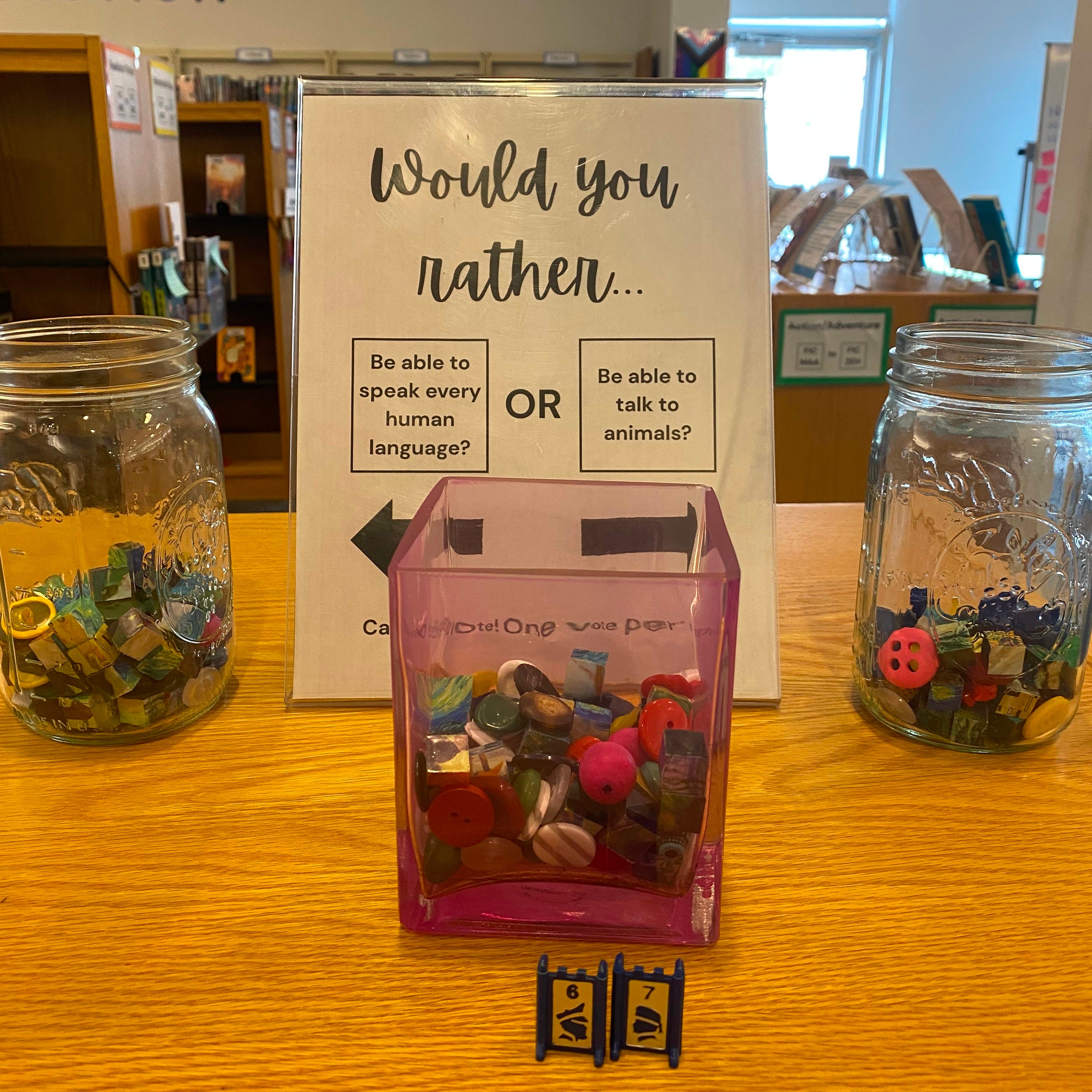
Last Week’s Would You Rather
Would you rather be able to speak every human language or talk to animals? Peep the “6-7.”

Conference Roundup
A could weekends ago, I attended the Massachusetts School Library Association conference. I always come away from this conference with renewed energy and lots of inspiration from the amazing things other librarians are doing across the state. I have a tendency to want to do ALL THE THINGS and bite off more than I can chew, so I’m grateful that April break is intervening and giving me some time to reflect before putting these new ideas into action.
Collaboration & Change
The theme of our conference was “Collaboration is our superpower.” Our keynote speaker, AASL President Amanda Kordeliski, encouraged us that collaboration comes in many forms, all of which build towards systemic change in our school communities.
Kordeliski asked us to consider the following questions:
What is your definition of collaboration?
What does successful collaboration look like?
Her questions got me thinking about when I was in library school. Co-planning and co-teaching were marketed to us as “true” collaboration, the hallmarks of a successful librarian. There’s value in this framing. For secondary librarians on a flex schedule, this kind of collaboration is the best way to teach information literacy skills to as many students as possible. If a librarian successfully initiates (or is sought after for) coplanning and coteaching, the librarian has made themselves indispensable to the school community. Indispensability is advocacy. In my library courses, other forms of collaboration (resource curation, push-in instruction, coaching) were framed as important in that they served as stepping stones to “true” collaboration, as a means to an end.
I think school librarians struggle a lot with imposter syndrome because we’re the only ones in our building (or district) with this role. It can be lonely, and when there’s an aspirational “true” form of collaboration out there, it can be easy to feel like we’re not doing enough. Obviously co-planning and co-teaching are incredible goals, but viewing other forms of collaboration as a means to an end cheapens the value we provide to our school communities in the meantime and contributes to that imposter syndrome.
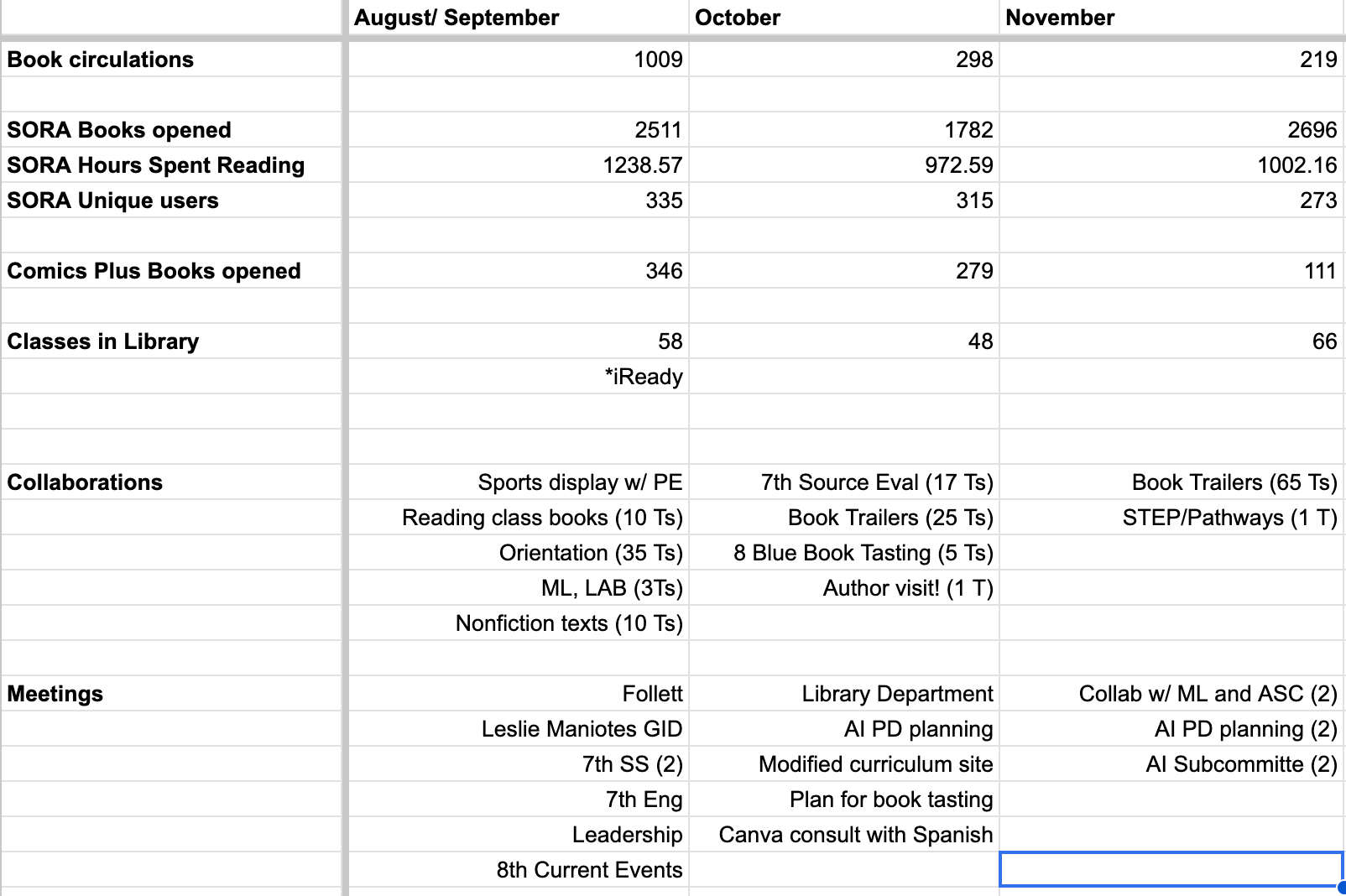
I keep a stats spreadsheet for my library - something I highly suggest doing if you don’t already! Under the “Collaborations” section, I used to only keep track of the big stuff: when a teacher and I created a book tasting, when I taught a research lesson in collaboration with a teacher, etc. Now I’m keeping track of the little things: creating modified summaries for a whole-class novel, helping a teacher set up templates in Canva, popping into an English class to help a small group of students find their book on audio in Sora. To me, collaboration is about what I do with people, but also for people. “For” leads to “with.” Because I created a modified summary of a whole-class novel, our special ed teachers were more receptive to my offer to push into their service blocks to help with a big end-of-year research project.
The crux of Kordeliski’s message was that systemic change does not happen overnight. It starts with small collaborations. It spreads by word of mouth. It happens at different paces across different grade levels, departments, and teachers. But it’s all progress. We should not devalue the ”lesser” forms of collaboration, for they, too, can lead to systemic change.
Workshops Galore!
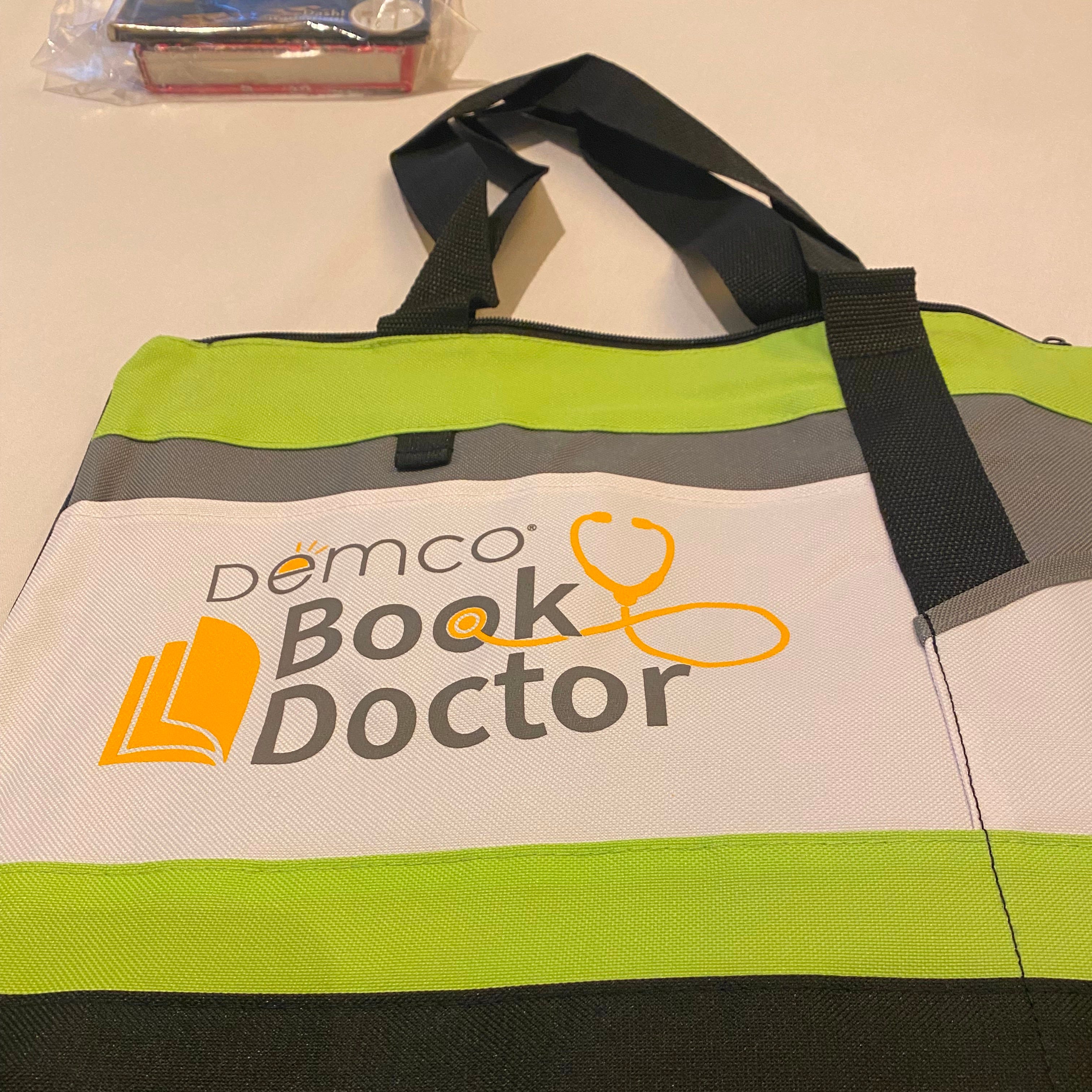
Throughout the conference, I was able to attend several amazing workshops, including the Demco Book Doctor. Apparently this is their last year going “on tour,” so if you are able to attend a workshop, I cannot recommend it enough. I learned new tricks for book repair, relearned some things I was doing very wrong (yikes), and got tons of free sample materials to test in my library. Check out the Book Doctor page on Demco’s website for video tutorials and a printout guide.
I also attended a fantastic collection development workshop on manga. She briefly reviewed the different kinds of manga then booktalked several series for teens and older teens, indicating whether each manga was ongoing or complete. A key collection development takeaway for long manga series: start by purchasing the first 5 and most recent 5, then backfill based on circulation. She also introduced us to The Graphic Library and The Manga Librarian - great resources for manga reviews while major journals are still incorporating manga into their repertoire.
The workshops I attended on student volunteers, media literacy, and primary sources gave me so many incredible ideas for long term planning as I think about next year. How can I revamp my student volunteer programming so kids are empowered to take the lead? How can I rebuild longstanding media literacy collaborations as our district changes curriculums? I’m excited to keep thinking about these topics over the summer and sharing what I learn with you!
Showcasing Student Work in the Library
For National Poetry Month, students in our multilingual learner program wrote “I Am From” poems to express their identity and culture. Some students wrote their poems in English, while others wrote in both English and their first language. It’s been a tradition to post these poems on a bulletin board outside the library, but this year the ML teachers and I collaborated on a display. Students visited the library to set up their poems alongside a favorite book or a book that connects thematically with their poems. This was a great opportunity for me to get to know students through their poems and get their input on the library collection.


Book Blanket and Reviews
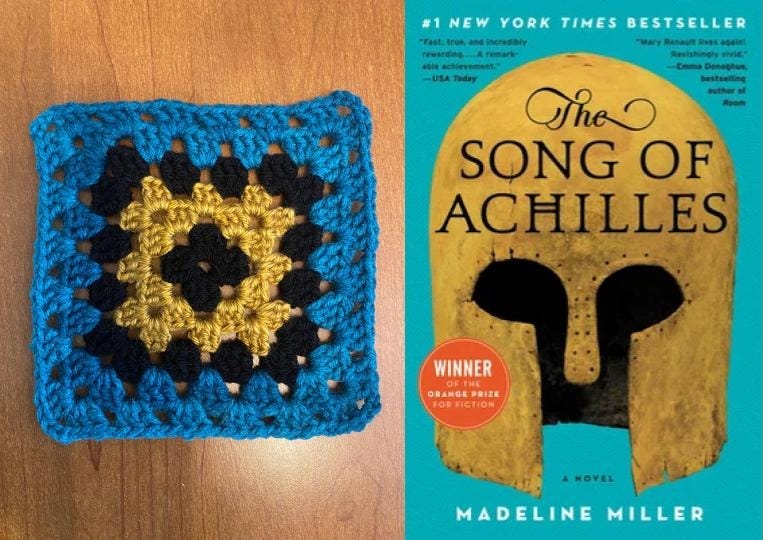
Book #17: Song of Achilles1 by Madeline Miller, 5 ⭐️
This retelling of the story of Achilles and Patroclus was full of gravitas and tenderness. Having read the Iliad and Odyssey with my students as an English teacher, seeing the role characters like Odysseus and Priam played in the story was like sitting down with old friends. Miller’s characters contain multitudes, and readers see through Patroclus’s eyes how it is possible to love someone who is deeply flawed. Song of Achilles is trending on BookTok right now, so if you’re thinking about buying it for your school library, know that it is best suited for high school audiences (one sex scene, frequent discussion of rape in the latter half of the book).
Checking out,
Jennie 🧡
I am a Bookshop affiliate, which means I earn a small commission on books you purchase through these links. Bookshop is a great alternative to Amazon, plus it supports indie bookstores! You can also find these books at your local library.