
📚 Notes from the Circ Desk, vol. 3

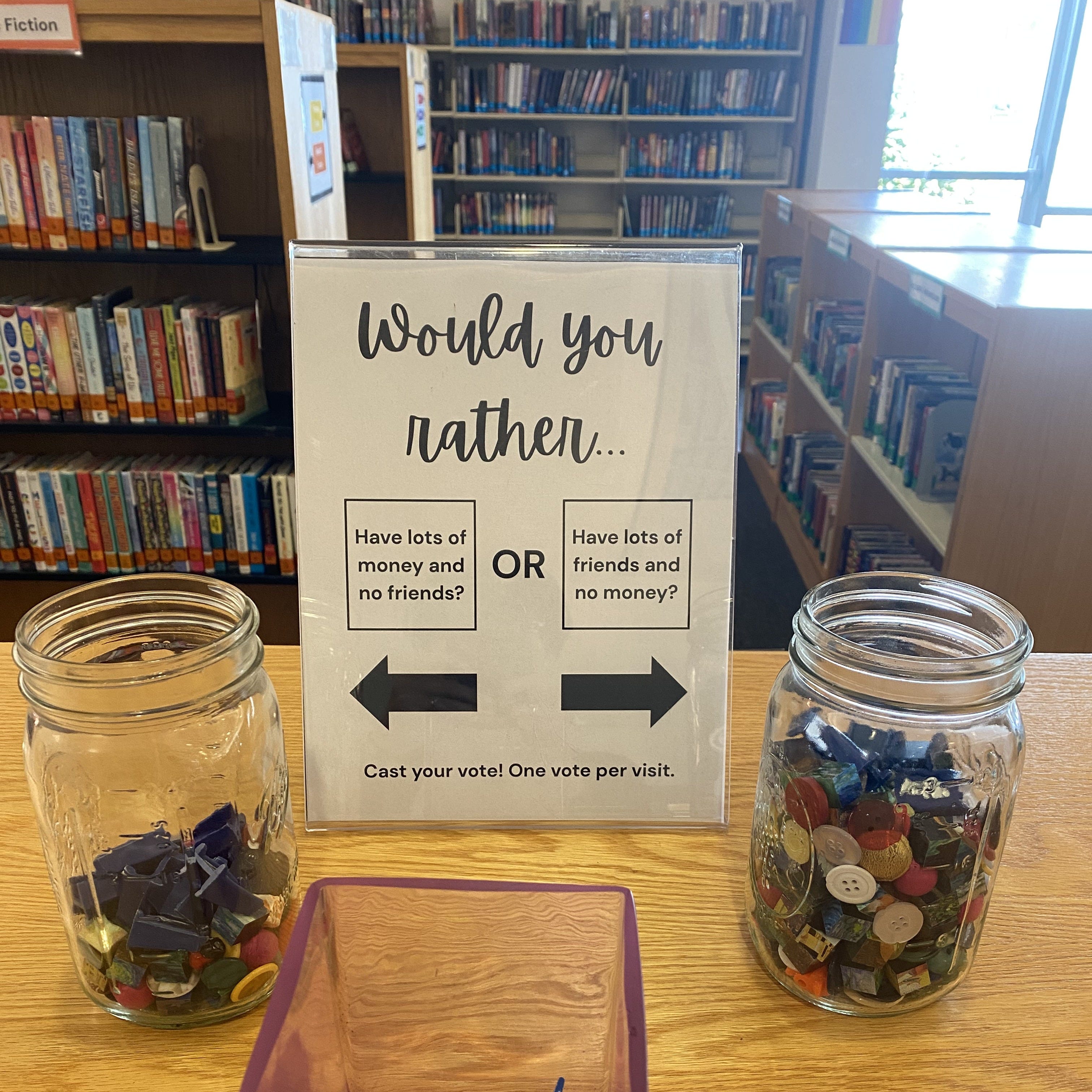
Last week’s Would You Rather: Would you rather have lots of money and no friends or lots of friends and no money? This one was a student suggestion. The results were hopeful!

This week I started another round of Book Trailer projects with the second of four 7th grade teams. Book Trailers are my Everest. I run the same project with each of the four 7th grade teams, and the project takes 5-6 days per team. I’m straight out from mid-October to Thanksgiving. It’s a great collaboration opportunity and a chance for me to get to know students by name, since I don’t teach a regular library class. But oh my goodness it’s a lot!
This project was started by the previous librarian as a collaboration between her and the 7th grade English teachers. Students use Canva to create a 90 second trailer about their independent reading books. The text of the trailer is a way for teachers to gauge student understanding of literary elements, and the trailer images, music, and animations help teachers gauge student understanding of mood. The previous librarian used this opportunity to teach a lesson about images and copyright. Last year I kept this lesson the way it was because I was getting used to my role, as I did with most of the lessons I inherited from this librarian. This year, I am starting to make these lessons my own and think critically about how I can adapt lessons to meet student needs.
During my first round of book trailers this year, I could literally see student eyes glaze over during the copyright lesson and watched their fingers itching to get back to their chromebooks to work on their trailers. I realized that this lesson was trying to do too much (copyright, public domain, fair use, Creative Commons). Instead, students needed more practical tips for finding and using images. I pared down the lesson to focus on copyright and Creative Commons, introducing these topics through the lens of fairness, creativity, and permission. I replaced a lengthy debate about a copyright event in the news with opportunities for students to try out the Creative Commons search methods and modeled some Canva image editing techniques. As a result, students had an opportunity to apply the lesson skills right away and more time to work on the project as a whole. They asked some really insightful questions and were using the terms copyright and Creative Commons correctly in conversation, perhaps because they weren’t inundated with other terminology. This is not to bash the previous librarian in any way - she designed a lesson on a really important concept (ethical content creation) in an era when copying and pasting from Google is the norm. All educators inherit lessons during their career and grapple with honoring the intent of the lesson while updating it for the students in front of them. We also grapple with how much direct instruction time to devote to overarching concepts versus the practical concerns of a project (How do I make an image black and white in Canva?).
The numbering project continues, and I thought I’d share some pictures. My hope is that this change makes book series easier for students to browse and makes the collection more accessible overall. I am doing this as books are returned, so not all series are numbered yet, but we’ll get there!


Lastly, I spent a good portion of this week building my next book order. This order was “boy-coded.” Sports books are in high demand this year, particularly sports graphic novels and sports that aren’t written about as much like hockey and lacrosse. I am also trying to find more fantasy and mystery books with male main characters. YA publishing is saturated with romantasy and mystery series like A Good Girl’s Guide to Murder right now, so female MC books dominated my purchasing last year. In addition to ordering new titles, I ran a lost book report, added new copies of high circulation titles and gaps in our series to the order. I was also able to add several French titles to the list to build up our World Language collection.
The final order was the largest order I’ve ever submitted, but that was on purpose. Our district is going through a 5th consecutive year of budget cuts, and my school’s office manager tipped me off that I should spend as much of my budget as possible by December to avoid a lower allocation next year. With the astronomical rise in healthcare costs, our district is putting all costs under the microscope. Now is the time for me to purchase the big ticket items I’ve been eyeing, like a new shelving unit for our World Language collection and new comfy chairs. This push to spend also moves up my timeline for updating our nonfiction collection. I don’t want to rush this process, but I also don’t want to risk lower funds in the future.
If you work in education, what’s your district’s budget situation like right now? If you’re in public libraries, are you seeing cuts as well? How is economic uncertainty affecting your collection development?
Checking out,
Jennie 🧡
I've been thinking about the rising costs of books and materials alot this week. I've been running reports to see how far our dollars are going and am finding fiction costs are sort of the same this time vs last time, but nonfiction book costs are really rising. I wonder if you find that too?